
Vanta alternatives.
There is an open-source option, there are cheaper ones, and the right answer depends on which framework you need and where you operate. This page answers those three questions before it mentions what we sell. Kaamos is one of the alternatives and it is the last section, so you can decide whether to read it.
Is there an open-source alternative to Vanta?
Yes. Comp AI is an open-source compliance platform published under AGPL-3.0, and it is the serious answer to this question today. You can read the source, run it yourself, and pay nothing for the software.
Self-hosting moves the cost rather than removing it. You take on running the thing, keeping integrations working, and the part no platform does for you: deciding what your controls are and persuading an auditor. If you have the engineering capacity and want the code under your control, it is a real option, and we would rather you heard that here than found it out afterwards.
Kaamos is not open source. If open source is a requirement rather than a preference, stop reading here.
What makes one platform cheaper than another?
Four things move a compliance quote, and only one of them is the sticker price. Ask every vendor to break their number down the same way before you compare anything.
- Frameworks in scope
- Almost every platform in this category prices by the number of frameworks you run. One framework is the entry package everywhere; the jump from one to three is usually the largest single step in a quote.
- Seats
- Per-user pricing is common, and compliance work pulls in engineers, legal and whoever owns each system. A tool priced per seat gets expensive precisely when you succeed at spreading ownership.
- Audit fees
- The auditor is not the software. A SOC 2 or ISO 27001 certificate is bought from an accredited body, separately, and no platform's price includes it. Compare quotes with the audit fee taken out of both.
- Implementation
- Onboarding, policy review and advisory time are sold as packages by some vendors and bundled by others. This is the line item that most often explains a large gap between two quotes for what looks like the same product.
Our own packages are published with the framework allowance on each one, so you can do this subtraction for us without a call: Kaamos plans and framework allowances.
Why does every recommendation contradict the last one?
Because the answer genuinely depends on which framework you need, where your company is, and whether you have someone inside who owns security. A team chasing a SOC 2 report for a US enterprise deal and a team facing NIS2 as an essential entity are not shopping for the same product, and a recommendation that ignores which one you are is worth what you paid for it.
The useful move is to take the same questions to every demo and compare the answers rather than the marketing. Each comparison below ends with the questions we would ask.
- Vanta
You want a broad trust platform with established audit workflows, questionnaire automation and configurable reporting.
- Drata
You want compliance monitoring, risk management and buyer-facing assurance, with options for a larger GRC program.
- Sprinto
You want automated compliance monitoring together with vendor risk and AI governance in a broader trust program.
- Secureframe
You want automated compliance and a product path into advanced vendor risk, access reviews or defense-sector requirements.
- Cyberday
You want a shared information security management system with framework guidance, tasks, employee participation and reporting.
- Secfix
You want European compliance automation with guided risk assessment, vendor reviews and cloud integrations.
- Kertos
You want privacy operations, an ISMS and AI governance together, supported by automation and compliance specialists.
Based on official product, help and package pages, reviewed . Tell us if anything here is out of date and we will re-read it.
Send a correctionWhere Kaamos fits, and where it does not.
Kaamos is built for EU teams whose requirement is a regulation rather than a customer questionnaire: NIS2, DORA, the AI Act, GDPR, and the national criteria that come with public-sector contracts. Evidence is read from your connected cloud, identity and code, and stays attached to the control it proves.
It is the wrong choice if you need open source, if your only requirement is a SOC 2 report for a US enterprise deal and you want the most established audit network, or if you want a large questionnaire-automation and trust-page operation. Those are real reasons to buy something else, and the comparisons above say which.
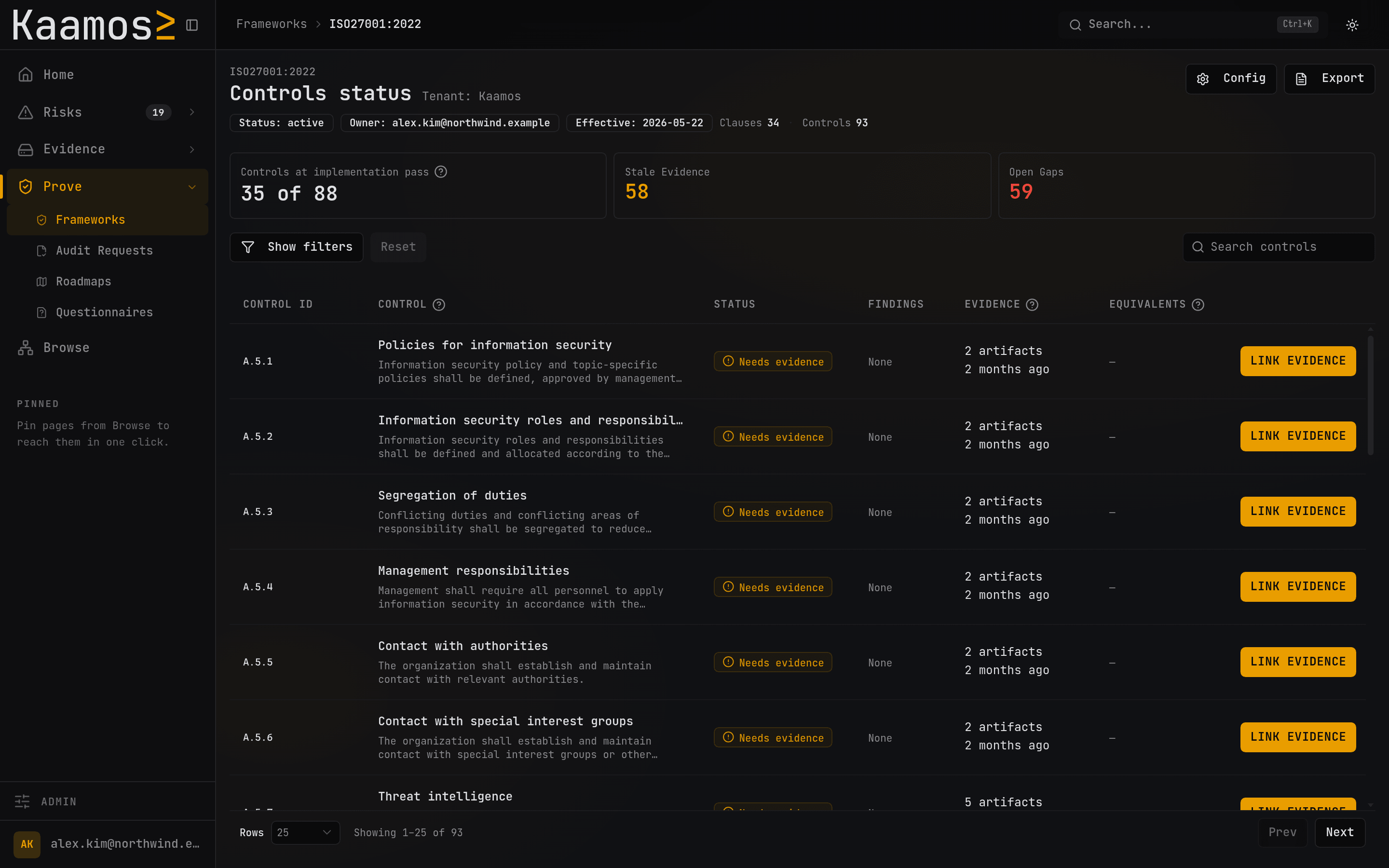
The comparison that decides it runs on your own systems.
Walk through your stack and target framework with a founder, and an honest answer about whether Kaamos is ready for it.